Environmental geography:
Environmental geography is the branch of geography the spatial aspects of interaction between human and the natural world. It require an understanding of the traditional aspects of physical humans geography as well as the ways in which human societies conceptualized the environment.
Environmental geography has emerged as a bridge between human and physical geography as a result of the increasing specialization of the two sub fields. Further more as human relationship with the environment has changed as a result of globalization and technological change new approach was needed to understand the changing and dynamic relationship.
Environment:
Environment is one of the most important issues of the world for last forty years green house effect ozone layers depletion CFC melting of glaciers etc are the hot issues for last few decades.
Environment means all of the outside forces events and things that act on a thing. A man environment is made up of everything that surrounds him including houses building people animals land temperature water light and other living and non living things. Environment can be defined as An environment is what surround a thing or an item.
Or
The totality of our surrounding is called our environment.
family, world, earth, human being, majorities, flats, buildings, houses, homes,and
Tuesday, 14 June 2016
Monday, 13 June 2016
mustard or rape seed
Mustard or rape seed:
It is very widely grown. It is a winter crop. Generally it is grown in association with other crop like wheat. But it matures earlier than wheat. Oil is obtained from the seeds. It is mainly used for cooking. The chief producing countries are india,Pakistan and Western European countries.
Sesame seed:
Oil extracted from the seeds. It require moderate temperature about 21° to 23°c. The rainfall for its well growth must be between 20 to 25 inches. It grown well in light loamy soils. It is used for cooking oil. The leading producers are India,Mexico's and China.
Sunflower:
Sunflower is one of the most important annual crops grown for edible oil purpose in the world next to soybean and pm oil. It has 40 50 percent oil in it's seed. The seed are consumed as human food as roasted nuts and nut meats besides extensive use as bird food. It has several advantage such as high yield potential matures in 90 to 120 days drought tolerant tolerate insects and disease iy grows in poor and well drained soil and rich in edible oil and protein. It is cultivated latrgelyin subtropical and warm temperature countries. It can be grown by rotation with wheat and cotton. It require high temperature and moderate rainfall.
The oil is of good and is used mainly for cooking. It cake is rich in digestible protein and fee from toxic elements which make it extremely useful for poultry and livestock. Due to short growth period sunflower has proved a very suitable crop. In tropical areas two crops are grown one in spring and other in autumn.....
Sunday, 12 June 2016
lumbering
Lumbering:
Forests are the densely populated areas of ttrees they are the association of plants predominantly same kind of trees.
Original forests covered about 50 percent of the land area of the earth. Man is so carelessly distracted the forests that they now cover only about 30 percent ofyhe world. Through the ages man was compelled to look to the forest for his shelter and fuel. With the passage of time new uses are being found directly and indirectly both ways which have modified it's importance.
Forests are the densely populated areas of ttrees they are the association of plants predominantly same kind of trees.
Original forests covered about 50 percent of the land area of the earth. Man is so carelessly distracted the forests that they now cover only about 30 percent ofyhe world. Through the ages man was compelled to look to the forest for his shelter and fuel. With the passage of time new uses are being found directly and indirectly both ways which have modified it's importance.
agricultural types practiced in the world
Mixed farming:
This form of agricultural is found in the highly developed parts of the world e.g. North western Europe, Eastern North America parts of Eurasia and the temperate latitude of southern continent.
Mixed farms and moderate in size and usually the crops associated with it are wheat barley oats rye maize fodder and root crops. Fodder crops are an important components of mixed farming. Crop rotation and inter cropping play an important role in maintaining soil fertility. Equal emphasis is laid on crop cultivation and animal husbandry's. Animal like cattle sheep pigs and poultry provide the main income along with crops. Building extensive use of chemical fertilizer and green manures and also by the skills and expertise of the farmers.
Dairy farming:
Dairy is the most advanced and efficient type of rearing of milch animals. It is highly capital intensive. Animal sheds storage facilities for fodder fedding and milching machine add to the cost of dairy farming. Special emphasis is it laid on cattle breeding health care and veterinary service.
It is highly labour intensive as it involves rigorous care in feeding and milching. There is no off season during the year as in the case of crop raising.it is practiced.mainly near urban and industrial centers which provide neighborhood markets for fresh milk and dairy products. The development of transportation, refrigeration, pasteurization,, and other preservation have increase the duration of storage of various dairy products.
There are three main regions of commercial dairy farming.the largest is north western Europe the second is Canada and the third belt includes south eastern Australia New Zealand and Tasmania.
Market gardening and horticulture:
Market gardening and horticulture specialized into the cultivation of high value crops such as vegetables fruits and flowers solely for the urban markets. Farms are small and are located where there are good transportation links with the urban centre where high income group of consumer is located. It is both labour and capital intensive and lays emphasis on the use of irrigation. HYV high yield value seeds fertilizer insecticide green houses and artificial heating in colder region's..
This type of agricultural is well developed in densely populated industrial district of north west Europe north eastern USA and the Mediterranean region. The Netherlands specialized in growing flowers and horticulture crops especially tulips which are flown to all major cities of Europe. The region where Farmer specialized in vegetables only the farming is known as truck fatming. The stance of truck farms of from the market is governed by the distance that truck can be cover over night,hence the me truck farming.
In addition to market gardening a modern development in the industrial region of Western Europe and North America is factory farming. Livestock particular poultry and cattle rearing bus done in stalls and pens fed on manufactured feed stuff and carefully supervisied against disease. This requires heavy capital investment in terms of building,machinery for various operations, veterinary service and heating and lighting. One of the important features of poultry farming and cattle rearing is breed selection and scientific breeding.....!!!
This form of agricultural is found in the highly developed parts of the world e.g. North western Europe, Eastern North America parts of Eurasia and the temperate latitude of southern continent.
Mixed farms and moderate in size and usually the crops associated with it are wheat barley oats rye maize fodder and root crops. Fodder crops are an important components of mixed farming. Crop rotation and inter cropping play an important role in maintaining soil fertility. Equal emphasis is laid on crop cultivation and animal husbandry's. Animal like cattle sheep pigs and poultry provide the main income along with crops. Building extensive use of chemical fertilizer and green manures and also by the skills and expertise of the farmers.
Dairy farming:
Dairy is the most advanced and efficient type of rearing of milch animals. It is highly capital intensive. Animal sheds storage facilities for fodder fedding and milching machine add to the cost of dairy farming. Special emphasis is it laid on cattle breeding health care and veterinary service.
It is highly labour intensive as it involves rigorous care in feeding and milching. There is no off season during the year as in the case of crop raising.it is practiced.mainly near urban and industrial centers which provide neighborhood markets for fresh milk and dairy products. The development of transportation, refrigeration, pasteurization,, and other preservation have increase the duration of storage of various dairy products.
There are three main regions of commercial dairy farming.the largest is north western Europe the second is Canada and the third belt includes south eastern Australia New Zealand and Tasmania.
Market gardening and horticulture:
Market gardening and horticulture specialized into the cultivation of high value crops such as vegetables fruits and flowers solely for the urban markets. Farms are small and are located where there are good transportation links with the urban centre where high income group of consumer is located. It is both labour and capital intensive and lays emphasis on the use of irrigation. HYV high yield value seeds fertilizer insecticide green houses and artificial heating in colder region's..
This type of agricultural is well developed in densely populated industrial district of north west Europe north eastern USA and the Mediterranean region. The Netherlands specialized in growing flowers and horticulture crops especially tulips which are flown to all major cities of Europe. The region where Farmer specialized in vegetables only the farming is known as truck fatming. The stance of truck farms of from the market is governed by the distance that truck can be cover over night,hence the me truck farming.
In addition to market gardening a modern development in the industrial region of Western Europe and North America is factory farming. Livestock particular poultry and cattle rearing bus done in stalls and pens fed on manufactured feed stuff and carefully supervisied against disease. This requires heavy capital investment in terms of building,machinery for various operations, veterinary service and heating and lighting. One of the important features of poultry farming and cattle rearing is breed selection and scientific breeding.....!!!
environmental impact assessment
Environmental impact assessment:
An environmental impact assessment EIA of the possible impact positive or negative that a proposed project may have on the environment together of the natural social and economic aspects.
The purpose of the assessment is to ensure that decision makers consider the ensuing environmental impact when deciding whether to proceed with a project. The International Association for Impact Assessment IAIA defines an environmental impact assessment as the process of identifying predicting evaluating and decreasing he biophysical social and other relevant effects of development proposals prior to major decision being taken and commitments made...
The Need for Environmental Assessment:
Economic social and environmental changes are inherent to development. In order to predict environmental impacts of any development activity and to provide on opportunity to mitigate against negative impacts and enhance positive impacts the environmental impact assessment EIA producers was developed in the 1970s..
An EIA may be defined as:
"A formal process to predict environmental consequence of human development activities and to plan appropriate measure to eliminate effects and to enhance positive effects."
EIA thus has three main functions:
To predict problems
To find ways to avoid them and
To enhance positive effects
The third function is of particular importance. This EIA provides a unique opportunity to demonstrate ways in which the environment may be improved as part of the development process. The EIA also predicts the conflict and constraints between the propose project programme or sectoral plan and its environment. It provides an opportunity for mitigation measure to be incorporated to minimize problems. It enables monitoring programmes to be established to assess future impacts ad provide data on which managers can take decision to avoid environmental damage.
Consumption population technology resources:
A major of human impact on earth systems is the destruction of biophysical resources and especially the earth ecosystem. The total environmental impact of a community or of humankind as whole depends both on population and impact per person which in turn depends in complex ways on what resources Are being used whether or not those resources are renewable and the scale of the human activity relative to the carring capacity of the ecosystem involved. Careful resources management can be applied at many scales from economic sector like agricultural manufacturing and construction to work organization the consumption pattern of household and individuals and to the resources demand of individual good and service. On the initial attempt to express human impact mathematically was developed in the 1970s and is called the IPAT formula. This formulation attempts to explain human consumption in the term of three components; population number, levels of consumption affluence, and impact per unit of resources use which is termed technology because this impact depends on the technology used. The equation is expressed:
I=P×A×T
Where:I = Environmental impact, P=Population, A=Affluence, T=Technology.
An environmental impact assessment EIA of the possible impact positive or negative that a proposed project may have on the environment together of the natural social and economic aspects.
The purpose of the assessment is to ensure that decision makers consider the ensuing environmental impact when deciding whether to proceed with a project. The International Association for Impact Assessment IAIA defines an environmental impact assessment as the process of identifying predicting evaluating and decreasing he biophysical social and other relevant effects of development proposals prior to major decision being taken and commitments made...
The Need for Environmental Assessment:
Economic social and environmental changes are inherent to development. In order to predict environmental impacts of any development activity and to provide on opportunity to mitigate against negative impacts and enhance positive impacts the environmental impact assessment EIA producers was developed in the 1970s..
An EIA may be defined as:
"A formal process to predict environmental consequence of human development activities and to plan appropriate measure to eliminate effects and to enhance positive effects."
EIA thus has three main functions:
To predict problems
To find ways to avoid them and
To enhance positive effects
The third function is of particular importance. This EIA provides a unique opportunity to demonstrate ways in which the environment may be improved as part of the development process. The EIA also predicts the conflict and constraints between the propose project programme or sectoral plan and its environment. It provides an opportunity for mitigation measure to be incorporated to minimize problems. It enables monitoring programmes to be established to assess future impacts ad provide data on which managers can take decision to avoid environmental damage.
Consumption population technology resources:
A major of human impact on earth systems is the destruction of biophysical resources and especially the earth ecosystem. The total environmental impact of a community or of humankind as whole depends both on population and impact per person which in turn depends in complex ways on what resources Are being used whether or not those resources are renewable and the scale of the human activity relative to the carring capacity of the ecosystem involved. Careful resources management can be applied at many scales from economic sector like agricultural manufacturing and construction to work organization the consumption pattern of household and individuals and to the resources demand of individual good and service. On the initial attempt to express human impact mathematically was developed in the 1970s and is called the IPAT formula. This formulation attempts to explain human consumption in the term of three components; population number, levels of consumption affluence, and impact per unit of resources use which is termed technology because this impact depends on the technology used. The equation is expressed:
I=P×A×T
Where:I = Environmental impact, P=Population, A=Affluence, T=Technology.
Friday, 10 June 2016
Indus water treaty
Indus water treaty:
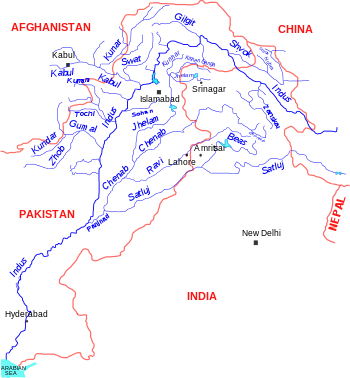
In 1947when Punjab was divided between the two countries many of the canal head works remained with India. The division of Punjab thus created major problems for irrigation in Pakistan.
On April 1 1948 India stopped the supply of water of Pakistan from every canal flowing from India to Pakistan. Pakistan protested and India finally agreed on an interim agreement on may 4 1948. This agreement was not a permanent solution therefore Pakistan approach the world bank in 1952 to help Settle the problem permanently. It was finally in ayub khan regime that an agreement was signed between India and Pakistan in September 1960. This agreement is known as the Indus of river and canals between the two countries. Pakistan obtained exclusive right for the three western rivers namely Indus, Jehlum and Chenab. And India retained rights to the three eastern rivers namely Ravi, Beas and and Sutlej. The treaty also guaranteed ten years of uninterrupted water supply. During this period Pakistan was to build huge dams financed partly by long term world bank loans and compensation money from india. Two multipurpose dams Mangla, and Tarbela were built. A system of eight link canals was also built and the remodeling of existing canals was carried out. Five barrages and a gated siphon mailsi were also costructed under this treaty...
The punjab rivers and barrages/head work;
Indus. Chashma IWT Taunsa
Jhelum. Rasul IWT
Chenab. Marala IWT Khanki Qadirabad IWT Trimmu.
Ravi. Balloki, Sidhnai IWT
Sutlej. Sulaimanki, Islam
Punjnad. Punjnad.
In 1947when Punjab was divided between the two countries many of the canal head works remained with India. The division of Punjab thus created major problems for irrigation in Pakistan.
On April 1 1948 India stopped the supply of water of Pakistan from every canal flowing from India to Pakistan. Pakistan protested and India finally agreed on an interim agreement on may 4 1948. This agreement was not a permanent solution therefore Pakistan approach the world bank in 1952 to help Settle the problem permanently. It was finally in ayub khan regime that an agreement was signed between India and Pakistan in September 1960. This agreement is known as the Indus of river and canals between the two countries. Pakistan obtained exclusive right for the three western rivers namely Indus, Jehlum and Chenab. And India retained rights to the three eastern rivers namely Ravi, Beas and and Sutlej. The treaty also guaranteed ten years of uninterrupted water supply. During this period Pakistan was to build huge dams financed partly by long term world bank loans and compensation money from india. Two multipurpose dams Mangla, and Tarbela were built. A system of eight link canals was also built and the remodeling of existing canals was carried out. Five barrages and a gated siphon mailsi were also costructed under this treaty...
The punjab rivers and barrages/head work;
Indus. Chashma IWT Taunsa
Jhelum. Rasul IWT
Chenab. Marala IWT Khanki Qadirabad IWT Trimmu.
Ravi. Balloki, Sidhnai IWT
Sutlej. Sulaimanki, Islam
Punjnad. Punjnad.
Thursday, 9 June 2016
human resources
Human resources:
Human resources mean no of people available to perform ajob or work. Human resources is a renewable natural resources. We can classify into the following.
Hi tech qualified professional
Skilled labour
Semi skilled labour
Non skilled labour..
Human resources management HRM: In simple words HRM means employing people developed their capacities utilizing maintaining and compensating their service in tune with the job and organizational requirements.
Human resources management HRM is seen by practitioners in the field as a more innovative view of work place management than the traditional approach. As such HRM techniques when property practiced are expressive of the goals and opreating practice of the enterprise overall.HRM s also seen by many to have a key role in risk reduction within organization.
The evolving occupational structure of the world:
People are the engaged in a variety of commercial activities in the world. Before the beginning of civilization man was engaged in only one primitive activity food gathering.
Then with the advancement in cultivation a civoilized life began. He then started to make tools and to exchange goods. As life became complex,more activities were added.
The distribution of the work face among the three sectors progresses through different stages as follows according of fourastie.
First phase : Traditional cultivation.
Primary sector 70%
Secondary sector 20%
Tertiary sector 10%
Second phase : Transitional period.
Secondary sector 50%
Tertiary sector 30%
Third phase: Tertiary a civilization.
Primary sector 10%
Secondary sector 20%
Tertiary sector 70%!!!!!!!
Human resources mean no of people available to perform ajob or work. Human resources is a renewable natural resources. We can classify into the following.
Hi tech qualified professional
Skilled labour
Semi skilled labour
Non skilled labour..
Human resources management HRM: In simple words HRM means employing people developed their capacities utilizing maintaining and compensating their service in tune with the job and organizational requirements.
Human resources management HRM is seen by practitioners in the field as a more innovative view of work place management than the traditional approach. As such HRM techniques when property practiced are expressive of the goals and opreating practice of the enterprise overall.HRM s also seen by many to have a key role in risk reduction within organization.
The evolving occupational structure of the world:
People are the engaged in a variety of commercial activities in the world. Before the beginning of civilization man was engaged in only one primitive activity food gathering.
Then with the advancement in cultivation a civoilized life began. He then started to make tools and to exchange goods. As life became complex,more activities were added.
The distribution of the work face among the three sectors progresses through different stages as follows according of fourastie.
First phase : Traditional cultivation.
Primary sector 70%
Secondary sector 20%
Tertiary sector 10%
Second phase : Transitional period.
Secondary sector 50%
Tertiary sector 30%
Third phase: Tertiary a civilization.
Primary sector 10%
Secondary sector 20%
Tertiary sector 70%!!!!!!!
natural gas
Natural gas:
Natural gas is a fossil fuel formerd over million off years geological pressure and changes. It is mixture of hydrocarbons gases that occur with petroleum deposits principally methane together with varying quantities of ethane propane butane and other gasesand is used as a fuel and in the manufacturing of organic compounds. When burned it is one of team cleanest and most power ful forms of energy available. Though it primarily consist of methane there are other hydrocarbons can be used as various sources of energy.
Major forms of natural gas:
CNG:
CNG stands for com pressed natural gas. It is safe fuel source that is commonly used in homes and businesses for heating lighting and cooking. CNG can be used as a fuel in cars d other vehicles displacing gasoline and Diesel with slight modifications to the fuel lines and tanks.
CNG is safe and quite BECUASE it is lighter than air and disperses quickly in case of a leaks or sprill. Its ignition temperature is higher than that of gasoline or diesel. Heavy duty natural gas vehicles are also up to 80% quieterthan the equivalent vehicle running on diesel..
LPG:
LPG stands for liquefied petroleum gas. In a gaseous state at normal atmospheric pressure and temperature LPG becomes a liquid at 15%c when pressure is lowred to between 1.7 and 7.5 bar. This facilitates both storage and transportation. Industry experts predicted that there will be enough LPG to satisfy anticipated demand for all uses in the foreseeable future.
LPG supply comes from two sources 66% is automatically generated from gas field as an associated gas when natural gas is extracted from the reservoir. A balance of 34% comes frome crude oil refining as about by product of the cracking process....
Natural gas is a fossil fuel formerd over million off years geological pressure and changes. It is mixture of hydrocarbons gases that occur with petroleum deposits principally methane together with varying quantities of ethane propane butane and other gasesand is used as a fuel and in the manufacturing of organic compounds. When burned it is one of team cleanest and most power ful forms of energy available. Though it primarily consist of methane there are other hydrocarbons can be used as various sources of energy.
Major forms of natural gas:
CNG:
CNG stands for com pressed natural gas. It is safe fuel source that is commonly used in homes and businesses for heating lighting and cooking. CNG can be used as a fuel in cars d other vehicles displacing gasoline and Diesel with slight modifications to the fuel lines and tanks.
CNG is safe and quite BECUASE it is lighter than air and disperses quickly in case of a leaks or sprill. Its ignition temperature is higher than that of gasoline or diesel. Heavy duty natural gas vehicles are also up to 80% quieterthan the equivalent vehicle running on diesel..
LPG:
LPG stands for liquefied petroleum gas. In a gaseous state at normal atmospheric pressure and temperature LPG becomes a liquid at 15%c when pressure is lowred to between 1.7 and 7.5 bar. This facilitates both storage and transportation. Industry experts predicted that there will be enough LPG to satisfy anticipated demand for all uses in the foreseeable future.
LPG supply comes from two sources 66% is automatically generated from gas field as an associated gas when natural gas is extracted from the reservoir. A balance of 34% comes frome crude oil refining as about by product of the cracking process....
petroleum
Petroleum:
Petroleum is a general term for crude oil and natural gas. Primary source of automative fuels and lubricant oils. Thought to have been formed from decomposition of animal and vegetables life under heat and pressure during geologic periods it occur usually in deep rock but sometimes near to the surfeve. When refined it produced hundred of petrochemical that are converted into unlimited products with new ones appearing continually. In most oil fields oil and natural gas occur together gas being the top layer on crude oil under which may lay water.
Top four largest oil deposits in the world: oil reserve left for about 40 years.
1 The piceance & unit basins USA discovery date: 1912
Est total resources: 2.855 trillion barrels Est remaining: 2.855 trillion barrels.
The total area covered by the deposits is about 41440sq. Kms.
2 The Orinoco belt Venezuela discovery date: 1930s
Est total resources: 1.3. Trillion barrels. Est remaining : 530 billion barrels...
3 The Alberta oil stans Canada discovery date: 1980
Est total resources: 173 billion barrels Est remaining: 169 billion barrels.
4 Ghawar Saudi Arabia discovery date: 1948
Est total resources: 162 billion barrels Est remaining: 107 billion barrels
Petroleum is a general term for crude oil and natural gas. Primary source of automative fuels and lubricant oils. Thought to have been formed from decomposition of animal and vegetables life under heat and pressure during geologic periods it occur usually in deep rock but sometimes near to the surfeve. When refined it produced hundred of petrochemical that are converted into unlimited products with new ones appearing continually. In most oil fields oil and natural gas occur together gas being the top layer on crude oil under which may lay water.
Top four largest oil deposits in the world: oil reserve left for about 40 years.
1 The piceance & unit basins USA discovery date: 1912
Est total resources: 2.855 trillion barrels Est remaining: 2.855 trillion barrels.
The total area covered by the deposits is about 41440sq. Kms.
2 The Orinoco belt Venezuela discovery date: 1930s
Est total resources: 1.3. Trillion barrels. Est remaining : 530 billion barrels...
3 The Alberta oil stans Canada discovery date: 1980
Est total resources: 173 billion barrels Est remaining: 169 billion barrels.
4 Ghawar Saudi Arabia discovery date: 1948
Est total resources: 162 billion barrels Est remaining: 107 billion barrels
Wednesday, 8 June 2016
cotton seed
Cotton seeds:
It is a by product of cotton cultivated for fiber. Oil is extracted from the cotton seed it is good substitute of animal fat. It is now the cheif ingredients of vegetables ghee and margarine in many countries. It is also used for cooking in salad dressing and soup making. The chief production countries are USA China India France CIS Common wealth to independent states Egypt and Pakistan.
Physical properties:
Once processed cottonseed oil has a mild taste and appears generally clear with a light golden color the amount of color depending on the amount of refining. It has a relatively high smoke point as a frying medium. Like other long chain fatty acid oil cottonseed oil has a smoke point of about 450 F° (232 C°).
Use in foods:
Cottonseed oil has traditional been used in foods such as potato chips and it's a primary ingredients in crisco the crisco the shortening product. But since it is significantly less expensive than olive oil or canola oil cottonseed has started to creep into a much wider range of processed foods including cereals bread and snack foods. Cottonseed oil resists rancidity so offers a longer shelf life for food product in which it is an ingredients...
It is a by product of cotton cultivated for fiber. Oil is extracted from the cotton seed it is good substitute of animal fat. It is now the cheif ingredients of vegetables ghee and margarine in many countries. It is also used for cooking in salad dressing and soup making. The chief production countries are USA China India France CIS Common wealth to independent states Egypt and Pakistan.
Physical properties:
Once processed cottonseed oil has a mild taste and appears generally clear with a light golden color the amount of color depending on the amount of refining. It has a relatively high smoke point as a frying medium. Like other long chain fatty acid oil cottonseed oil has a smoke point of about 450 F° (232 C°).
Use in foods:
Cottonseed oil has traditional been used in foods such as potato chips and it's a primary ingredients in crisco the crisco the shortening product. But since it is significantly less expensive than olive oil or canola oil cottonseed has started to creep into a much wider range of processed foods including cereals bread and snack foods. Cottonseed oil resists rancidity so offers a longer shelf life for food product in which it is an ingredients...
olives
Olives:
The olive is a fruit a tree grown in the Mediterranean lands southern Europe north Africa and south west Asia. It thrive best in Mediterranean climate hot dry summer cool and moist winters. Olive trees take 15 to 20 years to mature and then yield continuously for 100 years. The fruits are HARested in summer and processed immediately to maintain quality. Oil is extracted from olive fruits it is mainly used for cooking oil and salad. It is the finest and most highly priced of the edible oils.
The principal olive oil producing countries are the Mediterranean countries such as Italy Spain Greece Portugal France Turkey Tunisia Syria and Morocco. A small quantity it is also produced in California USA. Though it is used in small quantities in all parts of the world but the producing areas are the main consuming areas....
The olive is a fruit a tree grown in the Mediterranean lands southern Europe north Africa and south west Asia. It thrive best in Mediterranean climate hot dry summer cool and moist winters. Olive trees take 15 to 20 years to mature and then yield continuously for 100 years. The fruits are HARested in summer and processed immediately to maintain quality. Oil is extracted from olive fruits it is mainly used for cooking oil and salad. It is the finest and most highly priced of the edible oils.
The principal olive oil producing countries are the Mediterranean countries such as Italy Spain Greece Portugal France Turkey Tunisia Syria and Morocco. A small quantity it is also produced in California USA. Though it is used in small quantities in all parts of the world but the producing areas are the main consuming areas....
Subscribe to:
Posts (Atom)
-
AKABAR OR MAGHRABI TALEEM; CHA JO MAI NAE UN K TAREIKY AMMMAL PAE WAYEZ BOLEYK NAZAM ZAIL KOARKAM KAIE JIYE BAY INTHA MUFID HAI...
-
OUR COLLEGE: The name of our college is very grand. It is made of stone and bricks. It has 35 rooms. The rooms are airy. Every room v...